

Between approximately eighteen months and four years, young children experience an important developmental stage. In this age group, children develop what Dr. Maria Montessori referred to as a “Sensitive Period for Order and Autonomy.” At this stage, they begin to desire greater independence and self-control in performing tasks (e.g., selecting a jumper, pouring water) on their own. Since most parents spend quality time with their toddler in the home environment, and since bedrooms are one of the few places a child spends time daily, developing the toddler’s ability to be independent and assist with bedtime routines is a natural extension of supporting this type of development.
Start with the Bed and Floor Level Layout
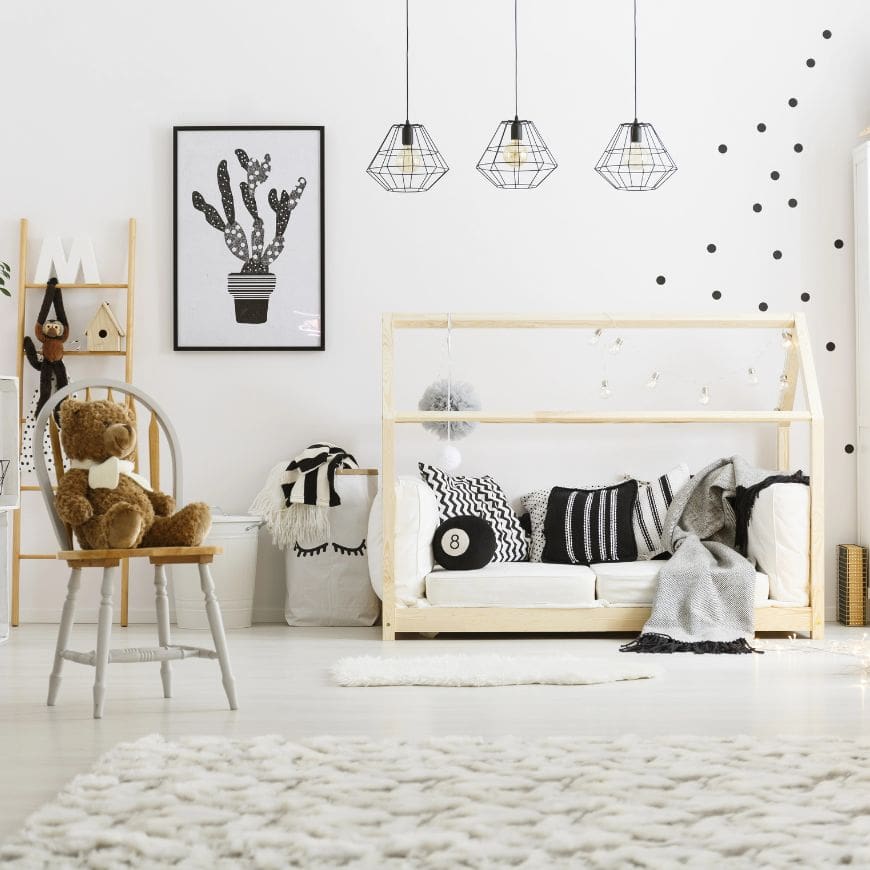
The single most influential piece of furniture in a toddler’s room is the bed. Traditional cots keep a child contained, which suits infants but works against a toddler who is ready to move freely. Low profile beds change the dynamic. Montessori floor beds sit close to the ground, usually between 10 and 25 centimetres high, which lets a child get in and out safely without adult help. The American Academy of Pediatrics recommends transitioning out of a cot once a child reaches around 89 centimetres in height or begins climbing out, whichever comes first, and a floor level bed is one of the recognised options for that transition.
When positioning the bed, keep it away from radiators, cords, and heavy furniture that could tip. A soft rug beside the frame protects against the occasional roll out during the first few weeks. Bedding should be simple. A fitted sheet, a light duvet appropriate for the room temperature, and one small pillow are enough for children over 12 months, in line with safe sleep guidance from The Lullaby Trust.

Make Storage and Clothing Accessible
Standard wardrobes are built for adults. Rails sit at shoulder height, drawers are heavy, and shelves stack items out of reach. For a toddler, this design communicates a clear message. You cannot do this without me. Reversing that message is straightforward.
Lower a single wardrobe rail to about 80 to 100 centimetres so a child can hang and retrieve their own clothes. Offer two or three outfit choices at a time rather than a full week, which prevents decision fatigue and keeps the space tidy. Open baskets work better than lidded boxes for underwear, socks, and pyjamas because the contents are visible at a glance.
A few practical measurements help here.
- Shelves for daily use: no higher than 90 centimetres
- Hooks for coats or dressing gowns: around 100 to 110 centimetres
- Chair or stool for dressing: seat height of 20 to 25 centimetres for most two to three year olds
- Mirror for self dressing: full length, secured to the wall, bottom edge at floor level
Rotating clothes seasonally keeps the wardrobe manageable. Anything out of size or off season belongs in storage elsewhere in the house, not in the child’s room.

Create Zones for Play, Reading, and Rest
Children are able to focus best when a space is divided into distinct sections. Three such areas include a “play area” with a small rug and an open toy shelf; a “reading nook” with a floor pillow and a wall-mounted bookshelf at child level; and a “resting area” centred on the bed.
Children will spend significantly longer periods playing and using their imagination with four toys than they would with sixteen. Therefore, limiting the number of available items to approximately 6-8 per shelf and rotating these items every 2-3 weeks has proven to be effective in practical terms.
A warm task light in the reading nook is beneficial. Ideally, it should be placed on either a timer or a touch dimmer which allows the child to adjust the lighting themselves.
Lighting across the whole room matters more than most parents realise. A ceiling light for general use, a warm bedside lamp with a low wattage bulb, and blackout curtains for daytime naps cover the main scenarios. Nightlights should emit red or amber tones rather than blue, which is less disruptive to melatonin production.
Additionally, make use of your child’s participation in small daily routines. Tasks such as making the bed, placing laundry into a basket, and replacing books back onto the shelves are feasible tasks once the environment is set up appropriately.